Waking up with a drooping face can be frightening. Suddenly, smiling feels different, drinking from a cup becomes difficult, or one eye may not close properly. Although these symptoms can look alarming, one possible cause is Bell’s palsy, a temporary condition affecting the facial nerve.
Fortunately, many people with Bell’s palsy improve over time. Furthermore, early medical treatment, proper eye care, and individualized rehabilitation may help support recovery.
If you are experiencing facial paralysis in Edmonton, AB, understanding what is happening — and what to do next — is an important first step.
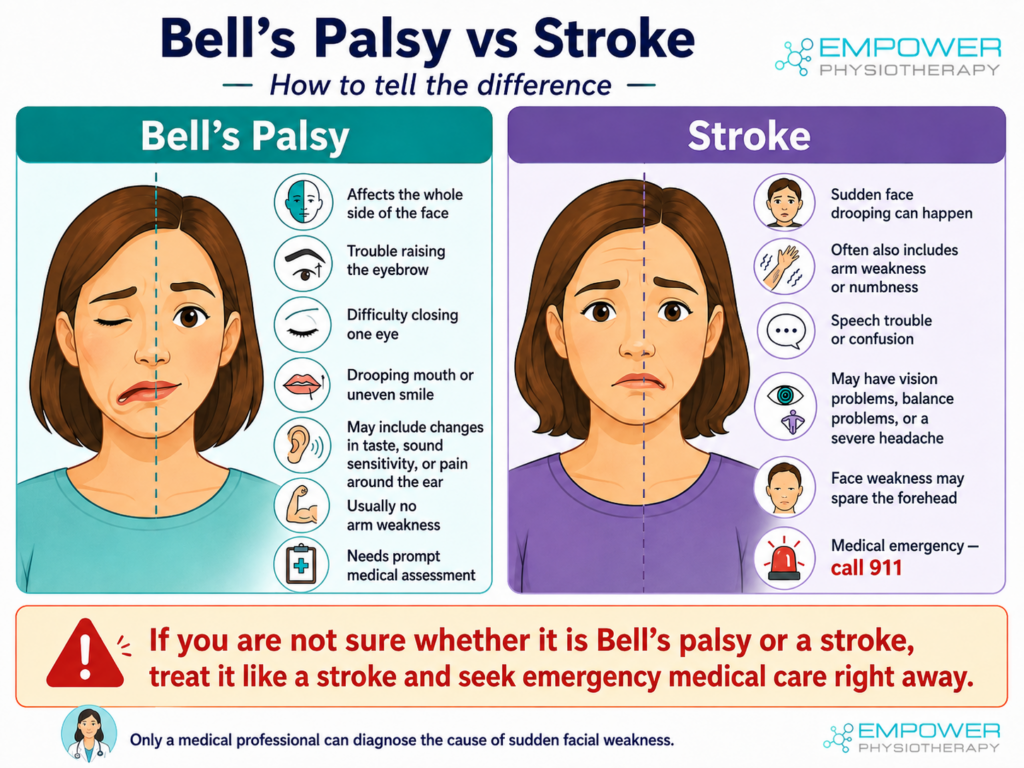
Important: Sudden facial weakness should always be medically assessed. Facial drooping can also be a sign of stroke, particularly when combined with arm weakness, speech changes, numbness, balance problems, or a severe headache. If these occur, call 911 immediately. See the FAST warning signs from Heart & Stroke Canada.
What Is Bell’s Palsy?
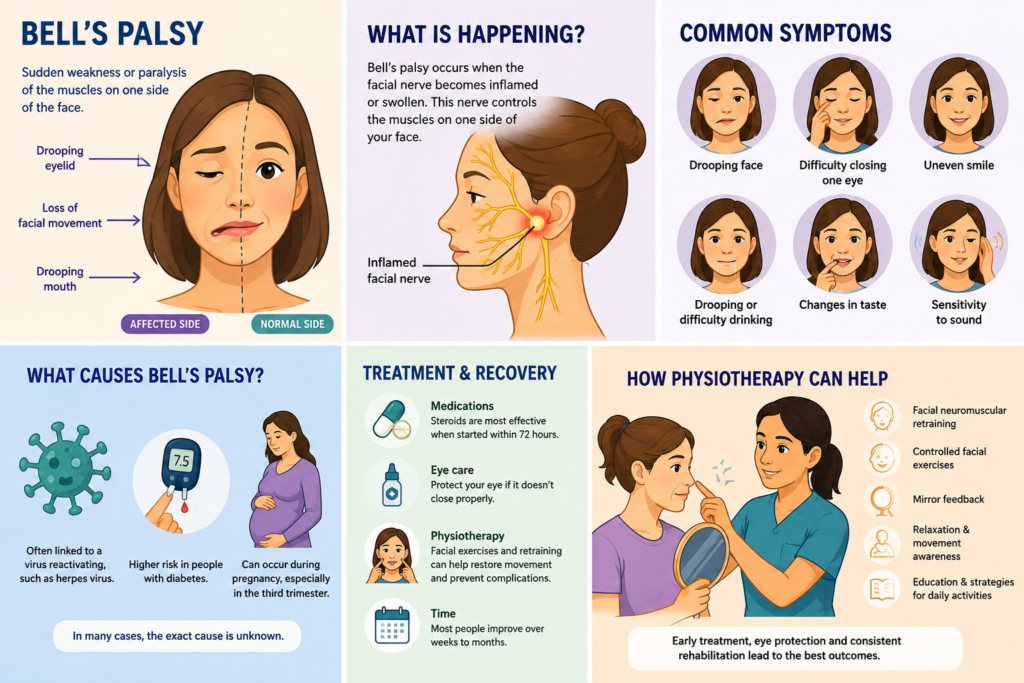
Bell’s palsy is a sudden weakness or paralysis of the muscles on one side of the face caused by a problem with the facial nerve, also called cranial nerve VII.
Because this nerve controls many facial muscles, Bell’s palsy may cause:
- A drooping face or uneven smile
- Difficulty closing one eye
- Trouble raising an eyebrow
- Drooling or difficulty drinking
- Changes in taste
- Increased sensitivity to sound
- Pain around or behind the ear
Symptoms typically develop quickly, often within hours to a couple of days.
What Causes Bell’s Palsy?
Interestingly, there is no single confirmed cause. Instead, researchers believe inflammation and swelling of the facial nerve play a major role.
Viral reactivation, particularly herpes-family viruses, has long been suspected. In fact, a large 2025 study involving more than 281,000 patients found strong associations between Bell’s palsy and herpes infections and diabetes (Neckel et al., 2025).
Nevertheless, Bell’s palsy remains an idiopathic condition, meaning doctors cannot identify one definite cause in most people.
Who Is More at Risk?
Bell’s palsy can affect almost anyone. However, certain factors appear to be associated with an increased likelihood of developing facial paralysis.
For example, people with diabetes appear to have a higher risk. Viral illness or reactivation may also contribute. Additionally, Bell’s palsy can occur during pregnancy, with pregnancy-associated cases appearing most often during the third trimester, although researchers continue to study this relationship (Jones et al., 2023; Neckel et al., 2025).
What Does It Take to Get Better?
Recovery is different for everyone. Nevertheless, many people gradually regain facial movement over several weeks to months.
Most importantly, early medical assessment matters.
Current evidence-based guidelines strongly recommend oral corticosteroids for eligible patients, ideally initiated within 72 hours of symptom onset, as they improve the likelihood of facial nerve recovery (Lee et al., 2026). Antiviral medication may sometimes be added depending on the severity and individual situation.
Meanwhile, if the eyelid does not close completely, protecting the eye from dryness and injury is extremely important.
As movement begins returning, rehabilitation can then focus on restoring normal, coordinated facial movement.
How Can Physiotherapy Help Bell’s Palsy?
Physiotherapy for Bell’s palsy is not simply about “strengthening” the face.
Instead, a physiotherapist with experience treating facial paralysis may use gentle, individualized techniques such as:
- Facial neuromuscular retraining
- Controlled facial movement exercises
- Mirror feedback
- Relaxation and movement-awareness techniques
- Education about facial movement patterns
- Strategies to manage stiffness or unwanted movements
A 2024 systematic review and meta-analysis found that physiotherapy may improve facial recovery and facial function; however, the overall certainty of the evidence remains low, so treatment should be individualized (Nakano et al., 2024).
Similarly, an earlier systematic review found growing evidence supporting tailored facial exercise therapy during both early and longer-term recovery (Khan et al., 2022).
What Should You Avoid With Bell’s Palsy?
More exercise is not necessarily better.
For instance, avoid repeatedly forcing exaggerated smiles, aggressively squeezing the eye shut, or performing high-effort facial strengthening without professional guidance. An international expert consensus specifically recommended against gross facial strengthening and routine electrical stimulation, while supporting education and neuromuscular retraining (Neville et al., 2024).
Additionally:
- Do not ignore an eye that cannot close properly.
- Do not delay medical assessment after sudden facial paralysis.
- Do not assume every drooping face is Bell’s palsy.
- Do not perform random online facial exercises aggressively.
What Are the Treatment Options for Bell’s Palsy?
Treatment may include several approaches depending on the individual:
1. Corticosteroids: The best-supported early medical treatment and ideally started within 72 hours when medically appropriate.
2. Antiviral medication: Sometimes prescribed alongside steroids, particularly in selected or more severe cases.
3. Eye protection: Lubricating drops, ointments, taping, or other physician-recommended strategies may protect an eye that cannot close fully.
4. Physiotherapy: Individualized facial retraining may help restore coordinated movement and manage lingering facial weakness.
5. Treatment for persistent symptoms: People who develop long-term tightness, facial asymmetry, or synkinesis — when one movement accidentally triggers another — may benefit from specialized rehabilitation and, in some cases, medical treatments such as botulinum toxin.
Getting Help for Bell’s Palsy in Edmonton, AB
A drooping face can affect much more than appearance. Smiling, eating, speaking, blinking, and even confidence can feel different.
However, you do not have to navigate recovery alone.
If you have been diagnosed with Bell’s palsy and are dealing with ongoing weakness, stiffness, facial asymmetry, or difficulty returning to normal facial movement, physiotherapy may be part of your recovery plan.
https://empowerphysioyeg.janeapp.com
Let’s work toward helping your face move naturally and confidently again.
References
Jones, H., Hintze, J., Slattery, F., & Gendre, A. (2023). Bell’s palsy in pregnancy: A scoping review of risk factors, treatment, and outcomes. Laryngoscope Investigative Otolaryngology, 8(5), 1376–1383. doi:10.1002/lio2.1136.
Khan, A. J., Szczepura, A., & Palmer, S. (2022). Physical therapy for facial nerve paralysis (Bell’s palsy): An updated and extended systematic review of the evidence for facial exercise therapy. Clinical Rehabilitation, 36(11), 1424–1449. doi:10.1177/02692155221110727.
Lee, S. A., Lee, H. Y., Kwak, M. Y., et al. (2026). Clinical practice guideline for the evaluation and management of facial nerve palsy. Clinical and Experimental Otorhinolaryngology. Advance online publication. doi:10.21053/ceo. 2026-00096.
Nakano, H., Fujiwara, T., Tsujimoto, Y., et al. (2024). Physical therapy for peripheral facial palsy: A systematic review and meta-analysis. Auris Nasus Larynx, 51(1), 154–160. doi:10.1016/j.anl.2023.04.007.
Neckel, N., Nahles, S., Heiland, M., Audebert, H., Zdunczyk, A., Guntinas-Lichius, O., Preissner, R., & Preissner, S. (2025). Risk factors associated with Bell’s palsy: A real-world analysis of 281,600 patients—European Journal of Neurology, 32(8), e70336. doi:10.1111/ene.70336.
Neville, C., Beurskens, C., Diels, J., MacDowell, S., & Rankin, S. (2024). Consensus among international facial therapy experts for the management of adults with unilateral facial palsy: A two-stage nominal group and Delphi study. Facial Plastic Surgery & Aesthetic Medicine, 26(4), 405–417. doi:10.1089/fpsam. 2023.0101.