Why Lateral Elbow Pain Happens — and How Physiotherapy in Edmonton, AB Can Help
If you have pain on the outside of your elbow when you grip, lift, type, carry groceries, or twist open a jar, you might be dealing with Tennis elbow. Although the name sounds sports-specific, most people who get it do not play tennis. Instead, this condition usually builds up gradually from repeated strain through the wrist and forearm. In other words, it is often an overuse problem, not a one-time injury.
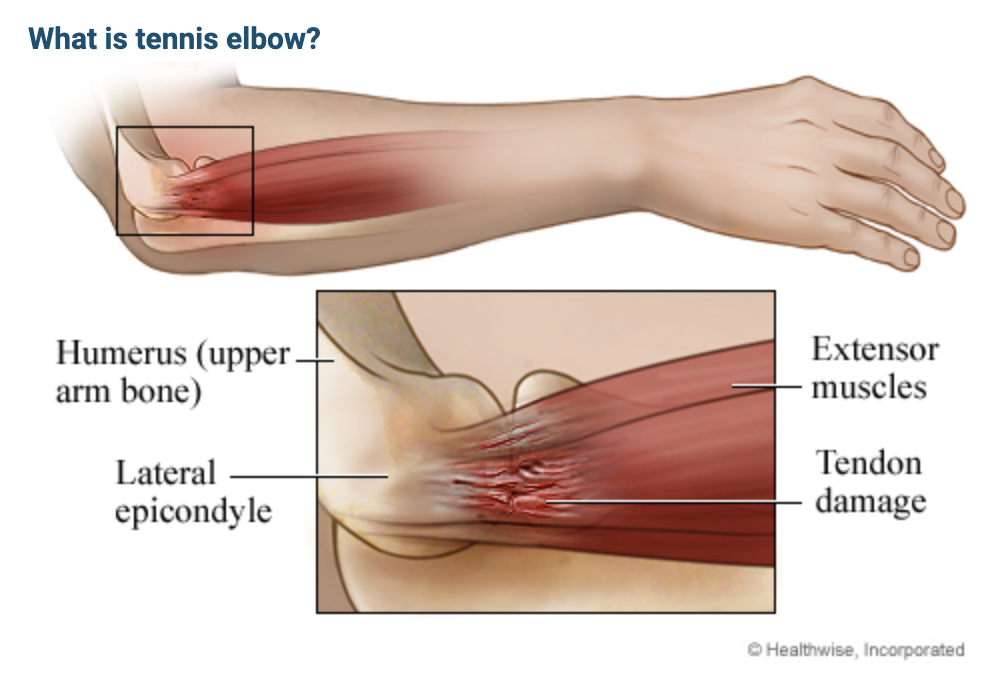
Clinically, Tennis elbow, also called Lateral epicondylitis or lateral elbow tendinopathy, refers to irritation and degeneration of the tendon that attaches the forearm “wrist lifting” muscles to the outside of the elbow. So, while people often describe it simply as elbow pain, the real issue is usually tendon overload. If this sounds like something you struggle with Book an Appointment.
What is Tennis elbow?
Tennis elbow is a common cause of lateral elbow tendinopathy and outer elbow pain. It tends to cause tenderness over the bony bump on the outside of the elbow, pain with gripping, and sometimes weaker grip strength. Symptoms often come on slowly, then become more annoying with repetitive tasks.
Even though the older term Lateral epicondylitis is still widely used, newer research and modern physiotherapy often prefer lateral elbow tendinopathy, because this better reflects a tendon overload problem rather than simple inflammation alone.
Who is at risk?
You may be more likely to develop Tennis elbow if you:
- do repetitive gripping, lifting, twisting, typing, tool use, racquet sports, or gym training,
- work in jobs with forceful, repetitive hand tasks or awkward wrist postures,
- are between about 40 and 60,
- keep pushing through pain without changing load.
So, whether you are a tradesperson, office worker, parent lifting kids, golfer, pickleball player, or recreational tennis player in Edmonton, AB, this problem can show up in daily life fast.
What does it take to get better?
First of all, the fastest way to improve Tennis elbow is not complete rest forever and it is not one miracle treatment. Instead, the best recovery plan usually combines temporary load modification, gradual strengthening, and patience. Recent reviews found that no treatment has strong evidence for dramatically faster pain relief than placebo in the short term; however, physiotherapy/exercise shows meaningful mid-term benefit.
That matters because tendon recovery is usually a process. In many cases, symptoms improve over weeks to months, and structured exercise programs are often continued for about 6 to 12 weeks or longer depending on irritability and chronicity.
How physiotherapy can help
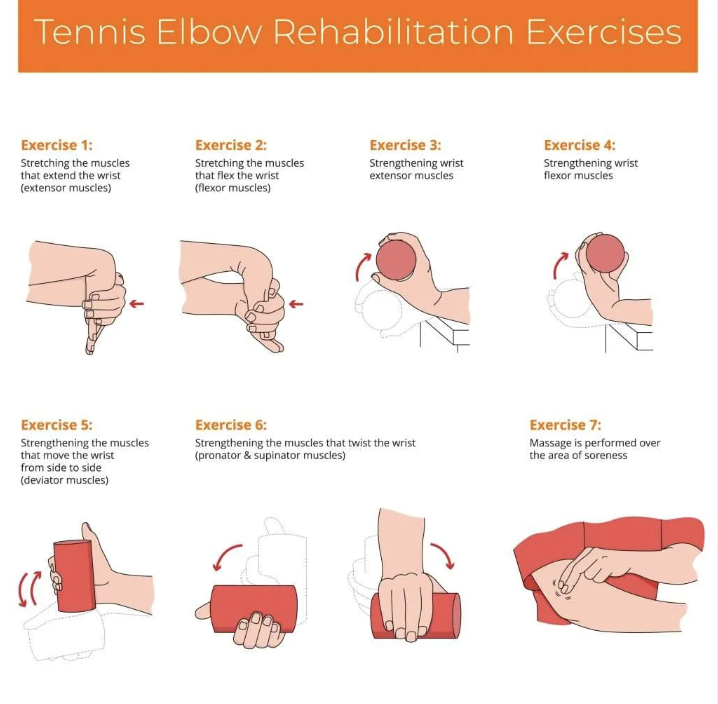
A physiotherapist can help by identifying what is overloading the tendon, calming pain down, and then rebuilding strength step by step. Research supports exercise-based care, and a recent Cochrane review found benefits from manual therapy and exercise for lateral elbow pain, while a 2024 network meta-analysis found physiotherapy/exercise had mid-term benefit over placebo.
Your rehab plan may include:
- education on pacing, grip load, and activity modification,
- isometric exercises for pain relief,
- progressive wrist extensor and forearm strengthening,
- shoulder and upper limb conditioning,
- manual therapy where appropriate,
- return-to-work, gym, golf, tennis, or pickleball guidance.
Some adjuncts, such as dry needling, shockwave, or other modalities, may help some people, but they should usually support — not replace — a strong exercise plan.
People also ask
What is the best doctor to see for tennis elbow?
For many people, a physiotherapist or a primary care/sports medicine doctor is a great first stop. The diagnosis is often clinical, and physiotherapists can assess, start treatment, and guide recovery early. If symptoms are severe, persistent, or the diagnosis is unclear, a sports medicine physician or orthopedic specialist may be helpful. Tennis Elbow (Lateral Epicondylitis)
What is the fastest way to cure tennis elbow?
There is no true instant cure. Nevertheless, the most effective path is usually to reduce aggravating load, avoid repeated painful gripping, and begin a progressive rehab program early. In short, smart loading beats total rest and “quick fixes.” Comparison of Interventions for Lateral Elbow Tendinopathy
What is commonly mistaken for tennis elbow?
Conditions that can look similar include radial tunnel syndrome/posterior interosseous nerve irritation, elbow joint problems, referred neck pain, and other tendon or nerve conditions. That is exactly why a proper assessment matters when outer elbow pain is not settling. Posterior Interosseous Nerve Syndrome
Helpful resources
For more reading, see the AAOS overview on Tennis Elbow, the ChoosePT guide, and the AHS overview. For more help, Physiotherapy Services and Book an Appointment.
Ready to get on top of your elbow pain?
If Tennis elbow, Lateral epicondylitis, or lateral elbow tendinopathy is making work, workouts, or sport harder than it should be, physiotherapy can help you move better, build strength, and get back to what you enjoy. If you are looking for treatment in Edmonton, AB, book an assessment today and let’s make a clear plan for your recovery Book an Appointment.
References
Lowdon, H., Chong, H. H., Dhingra, M., Gomaa, A.-R., Teece, L., Booth, S., Watts, A. C., & Singh, H. P. (2024). Comparison of interventions for lateral elbow tendinopathy: A systematic review and network meta-analysis for patient-rated tennis elbow evaluation pain outcome. The Journal of Hand Surgery, 49(7), 639–648. https://doi.org/10.1016/j.jhsa.2024.03.007
Wallis, J. A., Bourne, A. M., Jessup, R. L., Johnston, R. V., Frydman, A., Cyril, S., & Buchbinder, R. (2024). Manual therapy and exercise for lateral elbow pain. Cochrane Database of Systematic Reviews, 5, CD013042. https://doi.org/10.1002/14651858.CD013042.pub2
Bateman, M., Skeggs, A., Whitby, E., Fletcher-Barrett, V., Stephens, G., Dawes, M., Davis, D., Beckhelling, J., Cooper, K., Saunders, B., Littlewood, C., Vicenzino, B., Foster, N. E., & Hill, J. C. (2024). Optimising physiotherapy for people with lateral elbow tendinopathy: Results of a mixed-methods pilot and feasibility randomised controlled trial (OPTimisE). Musculoskeletal Science and Practice, 69, 102905. https://doi.org/10.1016/j.msksp.2023.102905
Ma, X., Qiao, Y.-Q., Wang, J.-Y., & Rong, J. (2024). Therapeutic effects of dry needling on lateral epicondylitis: An updated systematic review and meta-analysis. Archives of Physical Medicine and Rehabilitation, 105(11). https://doi.org/10.1016/j.apmr.2024.02.713
Shiri, R., & Viikari-Juntura, E. (2011). Lateral and medial epicondylitis: Role of occupational factors. Best Practice & Research Clinical Rheumatology, 25(1), 43–57. https://doi.org/10.1016/j.berh.2011.01.013